

WAPRO WaStop® vs. Duckbill Check Valves
In stormwater, sewer, and outfall applications, engineers and project managers have long relied on duckbill check valves as a go-to solution for backflow prevention. Affordable, familiar, and simple in concept, duckbill valves have been a standard specification for decades. But familiarity is not the same as performance, and in systems where available hydraulic head is limited, the difference between a duckbill valve and the WAPRO WaStop® inline check valve can be the difference between a system that functions and one that floods.
This article examines the fundamental hydraulic and operational differences between the two technologies, with particular focus on headloss – the factor most likely to determine real-world system performance.How Each Valve Works
Duckbill Check Valves
A duckbill check valve is a passive, rubber elastomer device shaped like its namesake. In its resting state, the bill pinches closed. When upstream pressure builds sufficiently, the rubber deforms and the bill opens, allowing flow to pass. When upstream pressure drops or backpressure increases, the elastomer contracts and the bill closes again.
This mechanism has an inherent hydraulic cost: the rubber must be physically deformed every time the valve opens. That resistance to deformation translates directly into headloss — energy that is consumed by the valve rather than driving flow through the system. Additionally, duckbills typically require a minimum cracking pressure to initiate opening, which can restrict low-flow conditions and reduce system responsiveness during the early stages of a storm event.
Over time, duckbill valves are also susceptible to degradation from UV exposure, biofilm accumulation, sedimentation in the bill, and chemical attack from sewage. Partial opening, where the bill does not fully deploy, becomes more common as the elastomer ages, compounding headloss and reducing throughput capacity.
WAPRO WaStop® Inline Check Valve
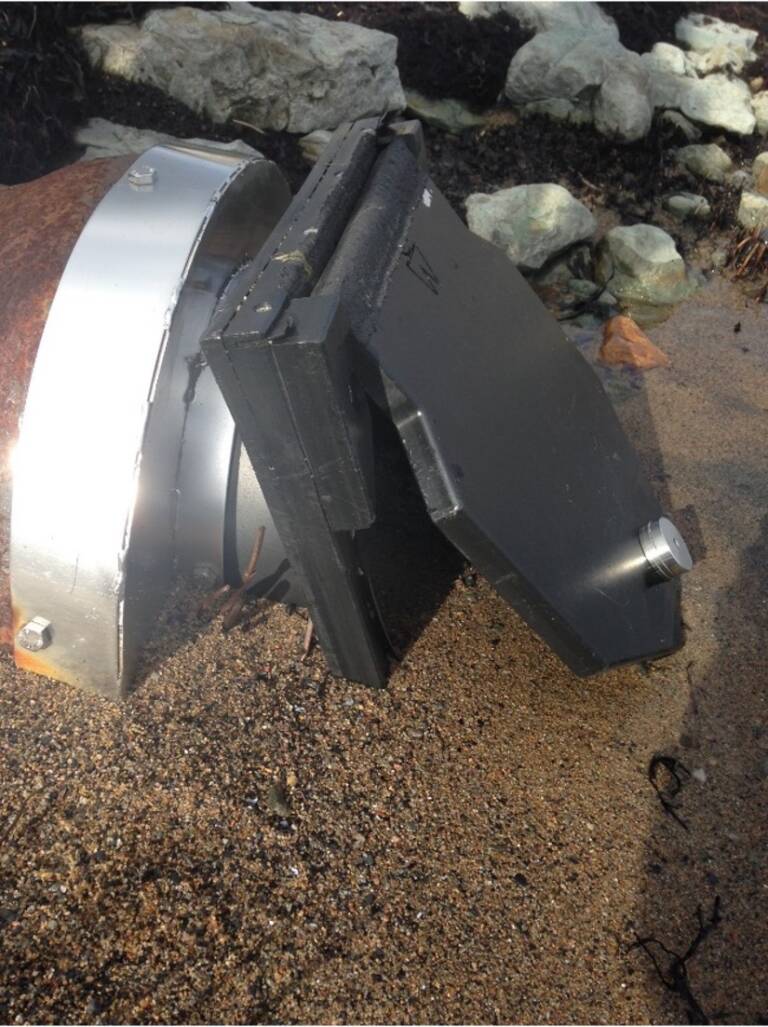
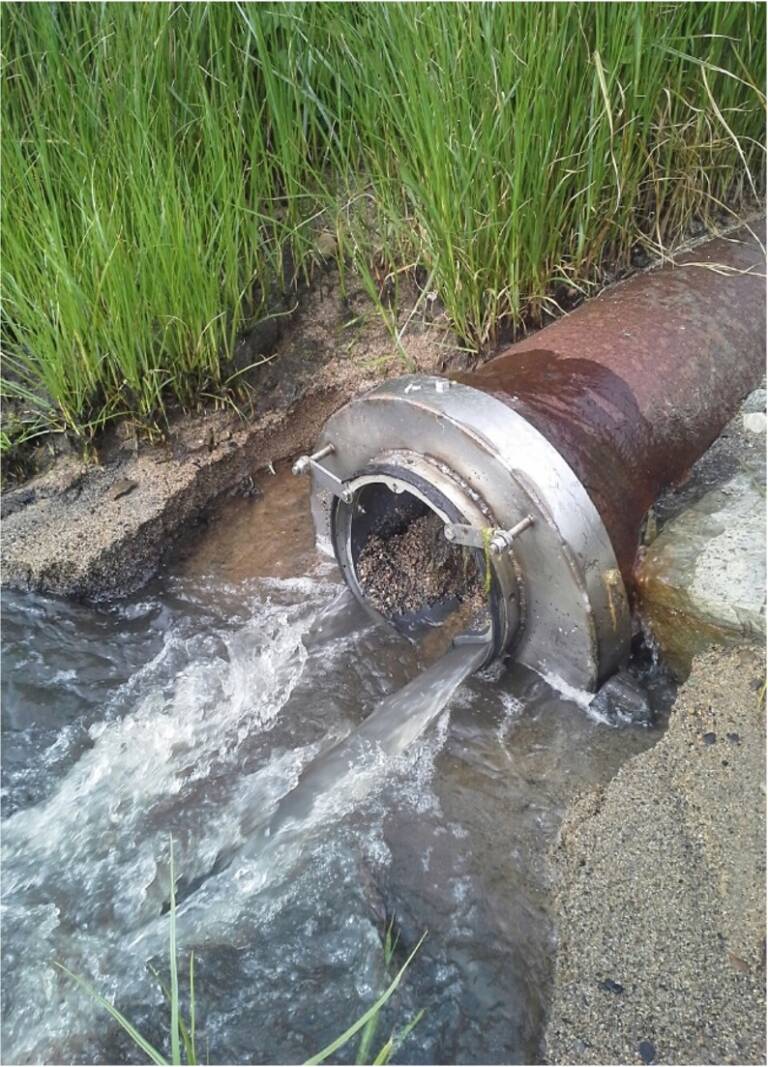
The WaStop® operates on a fundamentally different principle. A reinforced elastomer membrane sits inside a smooth, rigid stainless steel housing. In its resting (no-flow) state, the membrane seals the pipe completely — providing a positive, gastight barrier against backflow, odors, and vermin ingress. When upstream flow develops, the membrane flexes open along its length, conforming to the shape of the water passing through it.
Critically, the membrane does not need to be overcome by pressure – it adapts to flow. The thin, smooth membrane material has a low drag coefficient, and the rigid housing provides a consistently smooth bore that does not contribute meaningfully to turbulence. The result is the lowest headloss of any comparable inline check valve on the market, as confirmed by independent testing at Utah State University’s Utah Water Research Laboratory (UWRL).
The Headloss Difference: Why It Matters
In hydraulic systems, headloss is not a minor consideration — it directly determines how much flow the system can carry and whether upstream areas are at risk of flooding.
A pipe system operates on differential pressure. Higher upstream pressure relative to downstream pressure drives flow in the intended direction. Every component in the system consumes some of that available pressure as resistance — this is headloss. Major losses are attributable to the pipe itself; minor losses arise from fittings, bends, and valves.
The term “minor losses” is misleading. In flat or constrained systems, common in coastal areas, river floodplains, and low-lying urban environments – the available hydraulic gradient is already minimal. Adding a check valve with meaningful resistance can eliminate the margin that keeps the system flowing freely. Water accumulates upstream of the restriction, surcharge occurs in the network, and the risk of property flooding increases.
WAPRO’s headloss advantage stems from three design characteristics:
• A thin, smooth valve body that does not create turbulence at the entry point
• Membrane material with a low friction coefficient that offers minimal resistance to flow
• A flexible membrane that conforms to the flow profile, minimising turbulence and energy loss throughout the open state
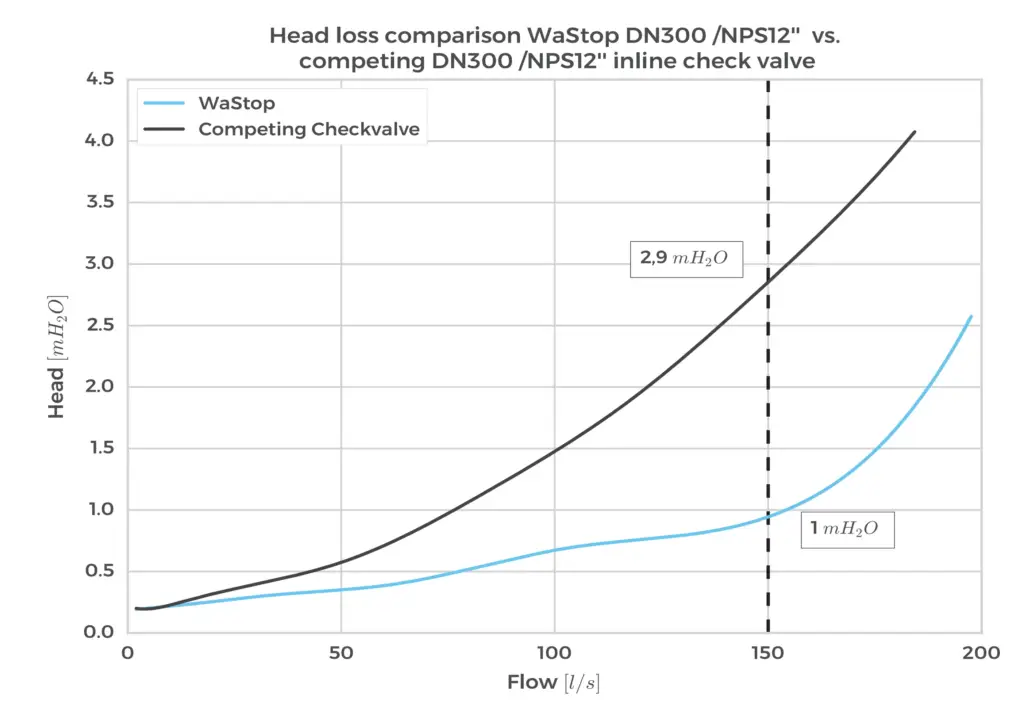
Comparing head loss data is difficult as the test procedure is rarely presented and there are multiple ways of altering data. However, the test results shown below were conducted in the same facility with the same reference points and are therefore comparable. The test result shows that the WaStop has 65% lower head loss than a competing inline check valve at flow 150l/s. Both valves were tested in the same open air
scenario.
Side-by-Side Comparison
Attribute |
Duckbill Check Valve |
WAPRO WaStop® |
| Opening Mechanism | Rubber deformation under pressure | Flexible membrane — low-resistance |
| Cracking Pressure | Higher — restricts low flows | Ultra-low — activates easily |
| Headloss | Significant — restricts capacity | Lowest on market (Utah State tested) |
| Seal When Closed | Relies on elastomer contact | Positive, gastight membrane seal |
| Odor / Vermin Control | Limited — gaps possible | Full seal against odors & pests |
| Aging / Biofilm | Degrades, partial opening common | Consistent performance over time |
| Flood Risk Contribution | Higher upstream accumulation | Minimal — maintains system capacity |
| Installation | Variable — may require excavation | Inline — fast slip-in installation |
| Independent Testing | Not publicly available | Utah State University (UWRL) |
Real-World Implications
System Capacity Preservation
When a stormwater or drainage system is designed, its hydraulic capacity is calculated to handle a defined storm event. Any additional resistance introduced after that design — whether from aging infrastructure, debris accumulation, or an added fitting — reduces available capacity. The WaStop’s low headloss ensures that installed capacity is not meaningfully eroded. With a duckbill valve, the headloss contribution must be explicitly accounted for in hydraulic modelling, and in marginal systems may require a design concession elsewhere.
Low-Flow Conditions
Early in a storm event, flow rates are low. A duckbill valve’s higher cracking pressure can delay or restrict flow at these lower velocities, creating backwater conditions at the very moment the system most needs to begin evacuating water. The WaStop’s low opening pressure means it responds to even gentle flow, maintaining throughput from the earliest stages of an event.
Ageing Performance
Elastomer duckbill valves degrade over time. Biofilm, sedimentation, UV exposure, and chemical exposure from sewage all contribute to reduced elasticity and incomplete opening. A duckbill valve that was performing adequately when new may be causing significant headloss five or ten years into its service life, without any visible indication of failure. The WaStop’s design mitigates this risk — the membrane operates within its elastic range rather than being compressed, and the smooth housing does not trap sediment in ways that impair function.
Odor and Pest Control
When a duckbill is not fully closed — due to sediment, partial deformation, or aging elastomer — it no longer provides a complete seal. This allows sewer gases and odors to pass upstream and, in some cases, enables rodents and insects to enter the pipe network. The WaStop’s membrane provides a positive, gastight seal when closed, regardless of the service life of the valve.
Installation and Lifecycle Cost
A common objection to WaStop is upfront cost. Duckbill valves are inexpensive and widely available. However, this comparison omits several significant factors:
- Installation speed: The WaStop is designed as an inline slip-in valve. Field feedback from St Augustine, Florida confirms that installation time from truck to in-pipe was shorter than the time taken to move the valve to the installation point. Reduced installation labour directly offsets higher material cost.
- System performance cost of duckbills: If a duckbill valve causes headloss that contributes to upstream surcharge or flooding, the cost of a single flood event — property damage, emergency response, liability — dwarfs the price differential between the two valves.
- Replacement frequency: Duckbill valves operating in demanding applications (heavy sediment, sewage, tidal fluctuation) typically require periodic replacement. WaStop’s stainless steel housing and reinforced membrane are engineered for extended service life.
- Design and compliance risk: As hydraulic modelling becomes more sophisticated and regulators impose tighter performance standards, specifying a valve whose headloss cannot be confidently quantified — or whose performance degrades over time — introduces engineering and compliance risk that a tested, documented valve avoids.
Basis of Design Specification
For engineers preparing contract documents or technical specifications, the following language supports a WaStop specification on a performance basis:
Inline Check Valve Performance Specification
Manufacturer: WAPRO WaStop® or approved equal meeting all performance criteria below.
Performance Requirements:
- Ultra-low headloss – Cv and headloss values verified by independent laboratory testing at minimum nine flow rates
- Low cracking pressure – valve must initiate opening at low flow to preserve system capacity
- Positive seal when closed – gastight against backflow, odor transmission, and vermin ingress
- Body: stainless steel housing; Membrane: reinforced elastomer
- Installation: inline within pipe, manhole, or outfall structure
Exclusions: Duckbill-type valves relying on elastomer deformation to open, and any valve with a cracking pressure or headloss profile that has not been independently verified, are explicitly excluded.
Conclusion
The duckbill valve is a product of its era, designed when sewer and stormwater systems were overbuilt relative to demand, and when headloss through individual fittings was considered a minor loss in every sense of the word. That era is over. Climate-driven intensification of rainfall events, ageing infrastructure with limited remaining capacity, and more rigorous hydraulic modelling have collectively raised the stakes on valve selection.
The WAPRO WaStop® was engineered from first principles to address exactly this context. Its membrane design provides the lowest headloss of any inline check valve, independently verified at Utah State University. It opens at low pressure, seals positively when closed, resists degradation, and installs quickly. For any system where available head is limited, which is to say, for most systems where backflow is a concern, the WaStop is the correct specification.
The decision rule is simple: if headloss matters in your system, WaStop is the valve that belongs in your specification.
References & Further Information:
- WAPRO WaStop Headloss Testing — Utah State University / UWRL
- WAPRO Third-Party Feedback (Field Testimonials)
- Independent testing scope: Competitor X DN200 (NPS 12”) headloss testing; WaStop vs Duckbill DN750 (NPS 30”) headloss test


